A survey report is read twice. Once when the client buys the house, and again, sometimes years later, when something goes wrong.
That second reading is the one every surveyor thinks about. A missed defect, a rating that doesn’t match the words beside it, a limitation that was never stated: these are where complaints and claims begin.
Providing advice to the public has always carried that risk. AI has not removed it. Used carelessly, it adds to it.
Across the sector we hear more and more about claims arising from reports where AI produced incorrect output and the surveyor relied on it too heavily. The tool wrote something confident and wrong, and nobody caught it before the client did.
There is far more to writing a survey with AI than pasting notes into a chatbot and hoping for a sound report.
Why a general chatbot is not a report writer
A general-purpose chatbot is built to produce fluent, confident text. That is exactly what makes it risky in a survey.
It doesn’t know what you saw. Give it a few notes and it fills the gaps with whatever sounds plausible. Mention that the property has a loft, and it may describe a loft conversion. Paste in the EPC, and a dormer or a rear extension can appear that you never inspected.
It doesn’t know the structure your report needs, how your condition ratings should be applied, or the wording your practice has settled on. It may write in the first person one paragraph and the third the next. It may recommend nothing where a further investigation was needed, or sound certain where you were not.
And it keeps no record of why it wrote what it wrote. When the report is questioned, there is nothing to show where each sentence came from.
The surveyor signs the report. Every one of those faults becomes the surveyor’s problem.
You can’t rely on an AI that hasn’t been prepared properly for the job.
Getting AI to write a survey well is not a weekend’s work. It has taken us hours upon hours, and hundreds of real surveys, to shape and test how SurvAI writes: what it is given, what it may draw on, and what it must never say.
The value is in the algorithm
The language model is only one part of a safe system. What matters is everything around it: what it is given, what it is allowed to draw on, and what is checked before a word reaches the client.
That is where we spent our time building SurvAI. Three ideas run through it.
- Evidence first: every section is written from what you recorded on site, and checked against it afterwards.
- Trusted sources: the model draws on guidance that has been chosen and reviewed, not on whatever it absorbed from the internet.
- Guardrails: rules that hold the wording, the ratings and the report as a whole to the standard, whatever the model produces.
Start from the evidence
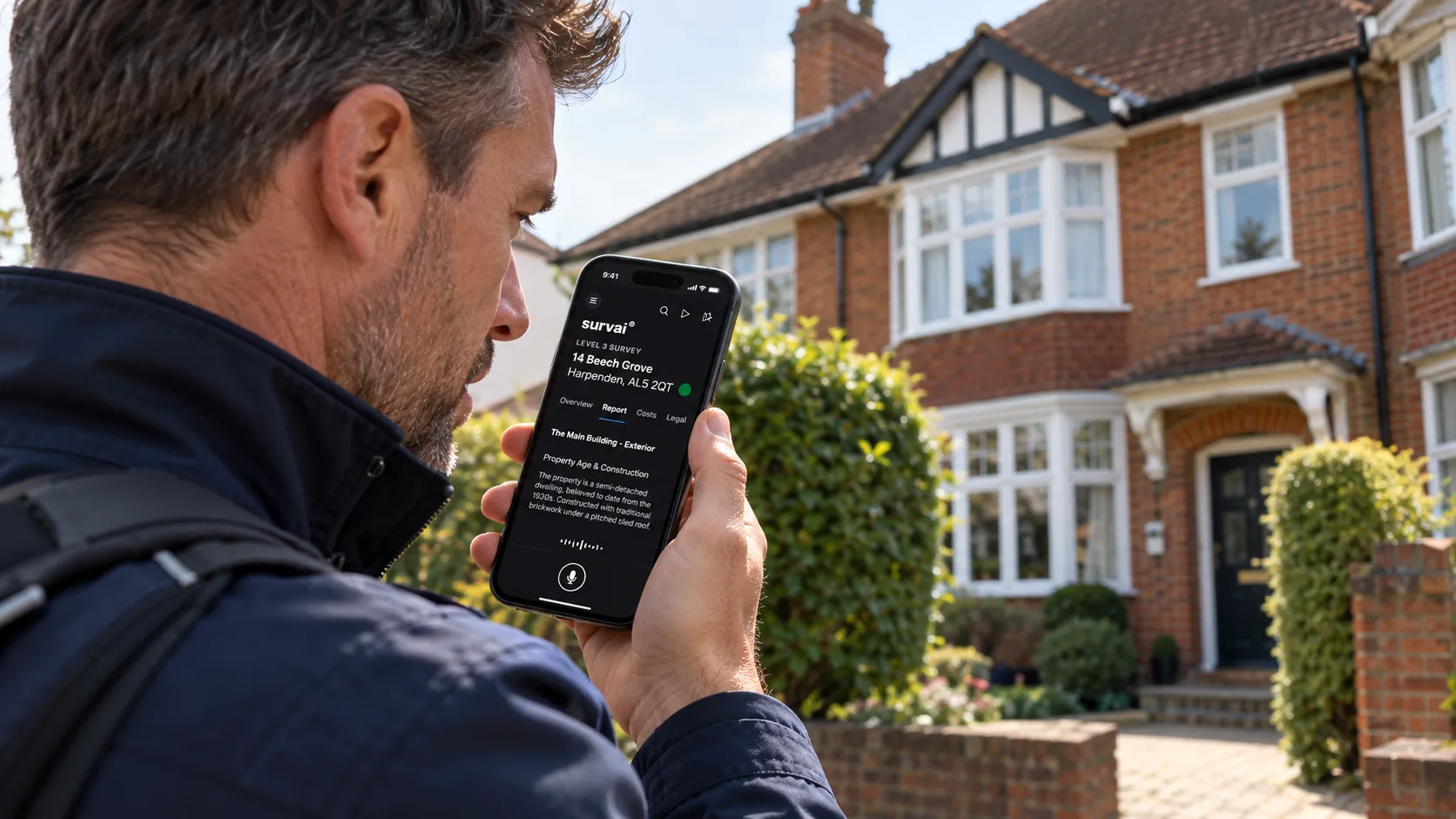
SurvAI writes each section from your own dictation, the transcript of what you said in the property, and the photographs you took. Your observations come first, and your wording wins.
Then the output is checked against that evidence. If a draft names a dormer, an extension, a conservatory, an outbuilding or a loft conversion that the transcript never mentions, the sentence is removed before you see it. The model does the writing; plain rules do the checking.
Photograph captions follow the same principle. A caption describes only what the photograph shows. It does not borrow a room or a defect from elsewhere in your notes, and anything a photograph cannot show, such as advice or a reading, is taken out.
An AI that writes only from the evidence is an AI whose every sentence you can trace.
Retrieval from sources you can stand behind
Retrieval-augmented generation, often shortened to RAG, means the model looks up relevant material from a chosen library before it writes, rather than relying on memory.
In SurvAI that library holds surveying guidance: how to structure each element, from identification through defects, consequences and the action needed, and the industry references a finding should rest on, such as BRE Digest 251 for assessing cracks in houses. When a section is written, the guidance for that section is retrieved and put in front of the model.
A practice can also build up its own settled positions on recurring issues. Only positions the practice has reviewed and settled are used, never one surveyor’s untested view, and they inform the judgement without ever adding a finding the evidence doesn’t support.
Standard wording, such as limitations and explanatory text, comes from your fixed-text library rather than being rewritten by the model each time.
Guardrails on every word
Even with good evidence and good sources, a model will sometimes slip. So SurvAI applies rules to the text after it is written.
The surveyor is always referred to in the third person. Vague phrasing that hides where a statement came from, such as “it was noted that” or “according to the transcript”, is cleaned up. Reports are written in paragraphs, in the order the report expects. Each change the rules make is logged, so you can see what was altered and why.
None of this replaces your reading of the report. It means that when you read it, you are checking judgement, not correcting the same mechanical errors again and again.
Quality control before the report leaves
Before a report is issued, SurvAI reviews it the way a careful reader would. It looks for the faults that tend to start disputes:
- a condition rating with nothing in the text to support it, or a rating that contradicts the wording beside it;
- a defect without a recommendation, or a recommendation the client can’t act on;
- a missing limitation, a missing further investigation or a legal matter the conveyancer should know about;
- overconfident language, placeholder text left behind, or parts of the report that contradict each other;
- a serious issue that never made it into the summary.
Each one is raised with its level of risk and a suggested fix. You decide: accept the fix, change the wording yourself, or dismiss it with a reason. If critical items are still open when you approve the report or produce the PDF, SurvAI tells you before it goes.
The surveyor stays responsible
RICS’ professional standard on responsible use of AI in surveying practice expects surveyors to apply professional judgement to AI output that affects their advice. We agree. A tool that hides how it reached its words makes that judgement harder.
In SurvAI you approve each section yourself. You can see the evidence behind it, listen to it read aloud and change anything you want. Changes made through SurvAI’s assistant are recorded with a reason and can be reviewed and reversed.
The inspection, the judgement and the signature remain yours. The system’s job is to make the report you sign a faithful record of what you found.
Questions to ask of any AI tool
Whether or not you use SurvAI, ask these questions before trusting any AI with your reports:
- Does it write only from my evidence, and does it check its output against that evidence?
- What sources does it draw on, and who chose them?
- What rules apply to the wording after the model has written it?
- What does it check before the report is issued, and does it tell me what it found?
- Can I see where each part of the report came from, and what was changed?
Speed is easy to sell. A report that stands up to its second reading is what protects your practice.