The report is nearly finished. Then you spot a recommendation that needs checking, a photograph in the wrong section and a sentence that could be misunderstood.
Another half-hour disappears. Dinner has gone cold.
For many residential surveyors, this is where the conversation about artificial intelligence becomes relevant. Beyond the headlines about machines replacing professionals, there is a practical question: could technology help us deliver good work without allowing that work to consume so much of our lives?
At Survai, our view is that AI’s most useful role in residential surveying is to augment the surveyor’s expertise.
It can help organise information, prepare drafts and support a more efficient working day. The inspection, the judgement and the responsibility still require serious professional attention.
A property is more than the information entered into a computer
Consider what happens during an ordinary inspection.
You notice an unfamiliar smell when you enter a room. You crouch to investigate the base of a wall. You decide where a moisture reading would be useful and consider what might influence the result. Where access is safe and within the agreed scope, you inspect the roof space and assess the visible structure.
You also decide what you cannot establish.
A stain may have several possible causes. A crack needs context. A newly decorated wall might deserve a second look. Information from an occupier may help, but it still needs to be considered alongside the evidence.
These decisions shape the investigation as it unfolds. The next useful observation often depends on what you have just discovered.
A report-writing system receives a representation of that inspection: your photographs, recordings, measurements and notes. It does not automatically receive everything you noticed, questioned or could not access.
That distinction matters. A beautifully written paragraph cannot compensate for missing evidence.
What about robots?
It would be a mistake to dismiss inspection robotics as science fiction. Robots already carry out specialist industrial inspections, including visual, thermal and acoustic checks. Boston Dynamics’ Spot is one example.
Future systems may perform more of the physical tasks involved in surveying. They would not necessarily need to resemble a person or perform every action in the same way.
However, replacing an entire residential inspection service presents a broader challenge. A system would need to deal reliably with unfamiliar layouts, restricted access, occupied homes, different construction types and unexpected conditions. It would also need a workable arrangement for interpreting evidence, communicating limitations and assigning responsibility.
Cost, maintenance and practical deployment would matter alongside technical capability.
Our expectation is that, for the foreseeable future, residential surveying will benefit most from technology that strengthens the professional’s capabilities. Individual tasks will change. Some may disappear. The profession should prepare for that change without assuming that the whole role becomes redundant.
Where AI can make a useful difference
Much of a surveyor’s time is spent turning observations into a coherent client document.
There are notes to organise, photographs to associate with findings, descriptions to prepare and recommendations to explain. Information may need to appear consistently across several sections or outputs.
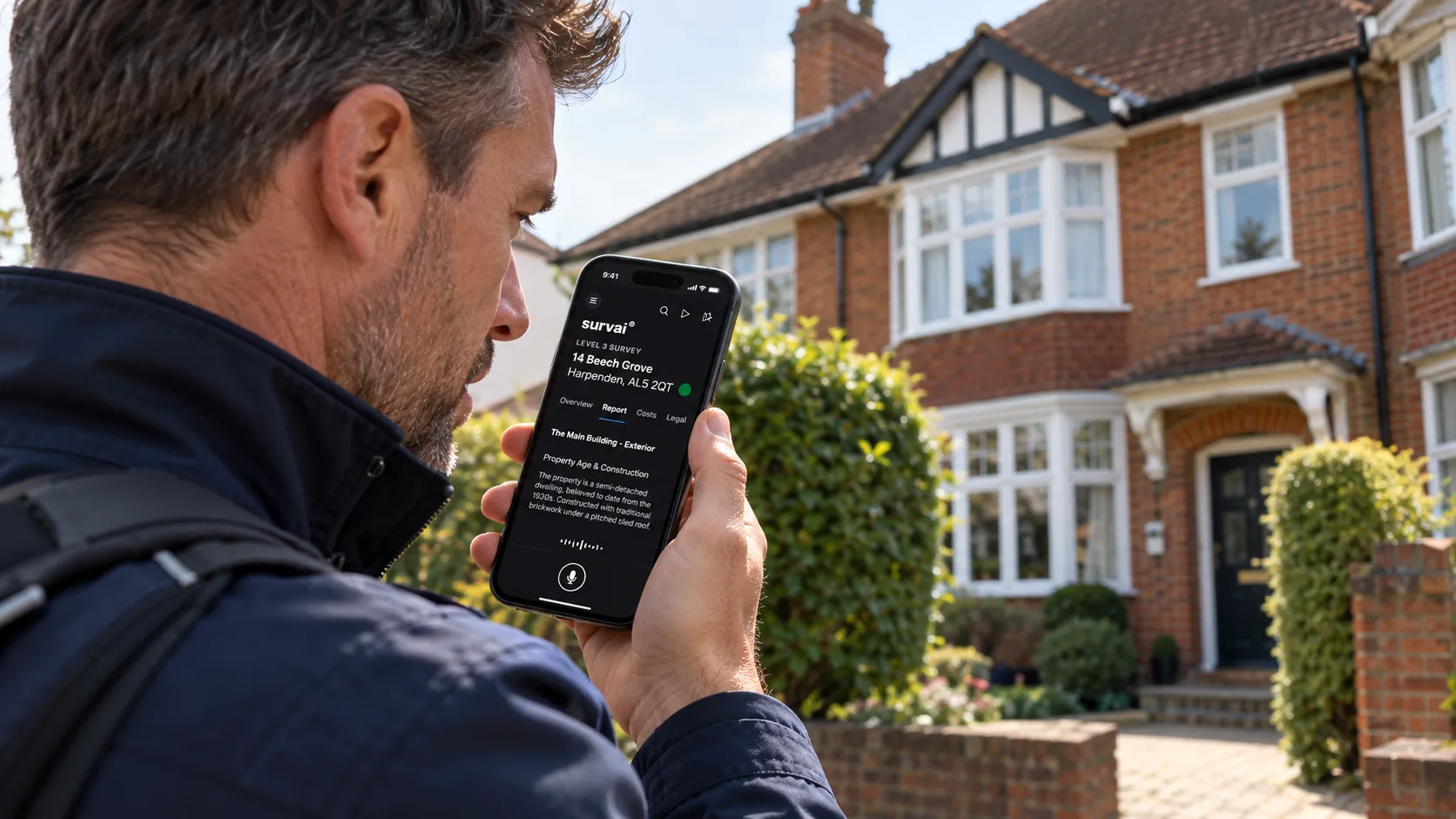
Appropriately designed AI tools can assist with this work. They can help turn spoken observations into a structured draft, propose clearer wording and flag possible inconsistencies for investigation.
The surveyor then checks whether the result reflects the property and the inspection.
For example, if the site record says that part of a roof space was inaccessible, the draft must preserve that limitation. It must not quietly turn a restricted inspection into an assurance about the whole roof.
Useful assistance makes the evidence easier to work with. It also makes gaps and uncertainty easier to see.
Fluent writing still needs scrutiny
A convincing report is not necessarily an accurate report.
An AI-generated passage can sound professional while making an unsupported assumption, confusing locations or recommending work that the recorded evidence does not justify.
A general-purpose chatbot can be useful for suitable tasks. The risk arises when its output is treated as finished professional advice without appropriate controls and review.
A specialist system should be judged by more than its name or the sophistication of its demonstration. Can findings be traced back to the inspection record? Are limitations preserved? Can the surveyor challenge and amend the draft? Has the workflow been tested on difficult cases as well as straightforward ones?
Additional training, fine-tuning and rules may improve performance, but they do not remove the need to check it.
RICS’ Responsible use of artificial intelligence in surveying practice, effective from 9 March 2026, places professional judgement and oversight at the centre of responsible adoption. For AI outputs materially affecting surveying services, the standard requires decisions about reliability to be documented, with responsibility accepted by an appropriately qualified, named surveyor.
Review is part of the professional service. It needs sufficient time, evidence and attention to be meaningful.
Security belongs in the conversation from the beginning
Surveying information can contain much more than details about a building.
Photographs may show personal possessions or family information. Instructions and correspondence may identify clients and occupiers. Recordings can capture information that was never intended for wider distribution.
Before using an AI service, a practice should understand what information it is providing, who receives it and what happens afterwards.
Useful questions include:
- Where is the information stored and processed?
- Who can access it, including service providers?
- Can uploads or outputs be used to train models?
- How long are records retained, and how does deletion work?
- What safeguards protect access, transfer and recovery?
- What happens if there is a security incident?
The ICO’s AI guidance addresses security and limiting personal-data use to what is necessary. It currently carries a notice that it is under review following the Data (Use and Access) Act, so practices should check the latest guidance when making decisions.
RICS also sets specific conditions for uploading private and confidential information to AI systems, including advance express written consent from affected stakeholders and reasonable steps to establish that the upload does not present an unacceptable risk. Those professional requirements should be considered alongside applicable data-protection obligations.
Security deserves clear explanations supported by evidence. Descriptions such as “advanced algorithms” do not, by themselves, explain how a client’s information is protected.
A better business should also mean a better working day
When fees are under pressure, reducing unnecessary administration can make a meaningful difference.
If a practice can prepare and check a report more efficiently while maintaining quality, it may lower its delivery costs, improve turnaround times or create capacity for additional work.
Those benefits need to be measured after allowing for software, training, checking and corrections. Faster drafting alone does not prove that the whole process is better.
There is also a choice about how to use the time recovered.
Some surveyors will want to grow their businesses. Others will want more time to explain findings to clients, develop their knowledge or finish work at a reasonable hour.
An evening with family is a worthwhile outcome. So is keeping a commitment to a friend, making time for exercise or being able to put the laptop away without feeling that the working day remains unfinished.
Adoption should be thoughtful, not fearful
Practices that learn to use suitable AI tools well may gain an advantage in efficiency and service. Refusing to consider them could mean missing useful improvements.
But adoption should begin with a clear task and a way of judging the result. Trial the workflow. Compare it with your existing approach. Examine the errors as carefully as the successes. Establish how information is protected and who reviews the output.
Surveyors should feel able to question AI, correct it and reject its suggestions.
The future of the profession will involve change. Our view is that expertise will remain essential to making that change useful.
Let technology take on more of the preparation, organisation and repetition. Give surveyors more room to inspect carefully, think clearly and explain what matters.
And, when the work is finished, more time to live.